The AmiWest 2026 schedule gave Jared McLaughlin a very appealing subject: blending classic and next-generation systems into an end-to-end Amiga synth/keytar music studio. The programme also describes his wider projects as focused on emulation and music.
This is our observer's article rather than a transcript. We are using Jared's scheduled session as the doorway into a question we have wanted to revisit: what would it mean to bring OctaMED back into a living Amiga music bench?
The official schedule is the source for the session description. The OctaMED reference at wiki.amiga.org and the Soundtracker Museum entry give the historical and technical background.
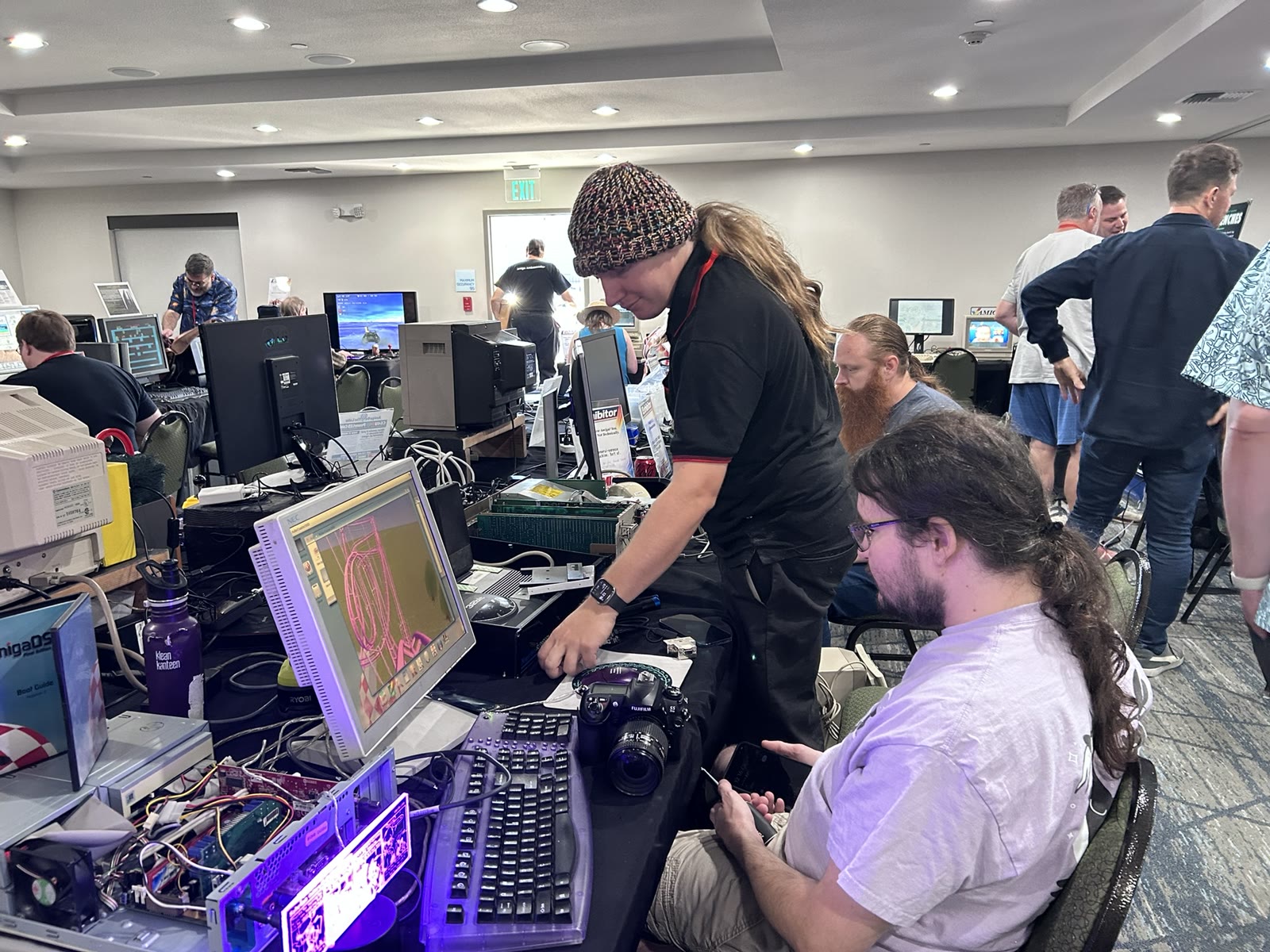
The music-studio idea belongs in this kind of setting: hardware open enough to inspect and a room full of people comparing notes.
Why OctaMED still makes sense
OctaMED was never just a nostalgia badge. It was a way to make a complete music idea fit inside a constrained machine: patterns, samples, timing, arrangement, effects and the musician's own ears all had to meet in one small workspace.
The OctaMED history and feature notes describe the continuing line through MIDI, ARexx, AHI, stereo and expanded channel support. That matters because the old workflow was already a kind of resource-aware composition. The machine told us what was possible, and the artist learned how to make the constraint expressive.
Jared's session points toward a larger studio
The schedule's phrase “classic and NG systems” gives us a practical direction. An Amiga 2000 MIDI workstation, a modern Amiga-compatible system, an emulator, or a connected synthesiser can each occupy a different role. The studio does not have to choose between preservation and new work. It can preserve the timing, interfaces and habits that made the older tools distinctive while letting newer hardware handle storage, display or connectivity.
We should be careful about attribution here. We did not record Jared's talk as a transcript, and we are not claiming that every idea in this article was presented during his session. We are following the direction named in the programme and connecting it to the OctaMED material that gives the idea its history.
A way back in for our own bench
For our own projects, bringing OctaMED back does not mean pretending 1990 has returned. It means choosing one small musical experiment and rebuilding the path around it:
- keep a known-good OctaMED or MED project;
- run it on an emulator or compatible Amiga system;
- connect one MIDI or audio device when the setup permits it;
- capture the settings and the result;
- write down which parts belong to the classic tool and which belong to the modern bridge.
That is the same evidence loop we use for editors and IRC clients. The software is old, but the practice is current: preserve the input, name the environment, make one change, and keep the result.
The music is a bridge, not a museum label
Jared's session is a useful reminder that Amiga preservation is not only about keeping disks readable. It is also about keeping creative workflows possible. OctaMED belongs beside the hardware, the emulator, the MIDI interface and the person who still wants to make something with all of them.
Our AmiWest show-floor recap has the wider weekend context, while the Chris Collins and Stefan Reinauer follow-up follows the development side of the same event.
Photos: Auzietek's AmiWest 2026 collection. Jared McLaughlin's session description comes from the official AmiWest programme; this article is our observational follow-up.