The Sunday AI Coding Workshop at AmiWest gave us a useful subject for a closer follow-up: what does modern assisted development look like when the target is still an Amiga we can boot, inspect and test?
This is our observer's note from the programme, the photographed workshop slides and the linked projects. It is not a transcript of the session. The official AmiWest announcement and the 2026 schedule are the right places for the full event context.
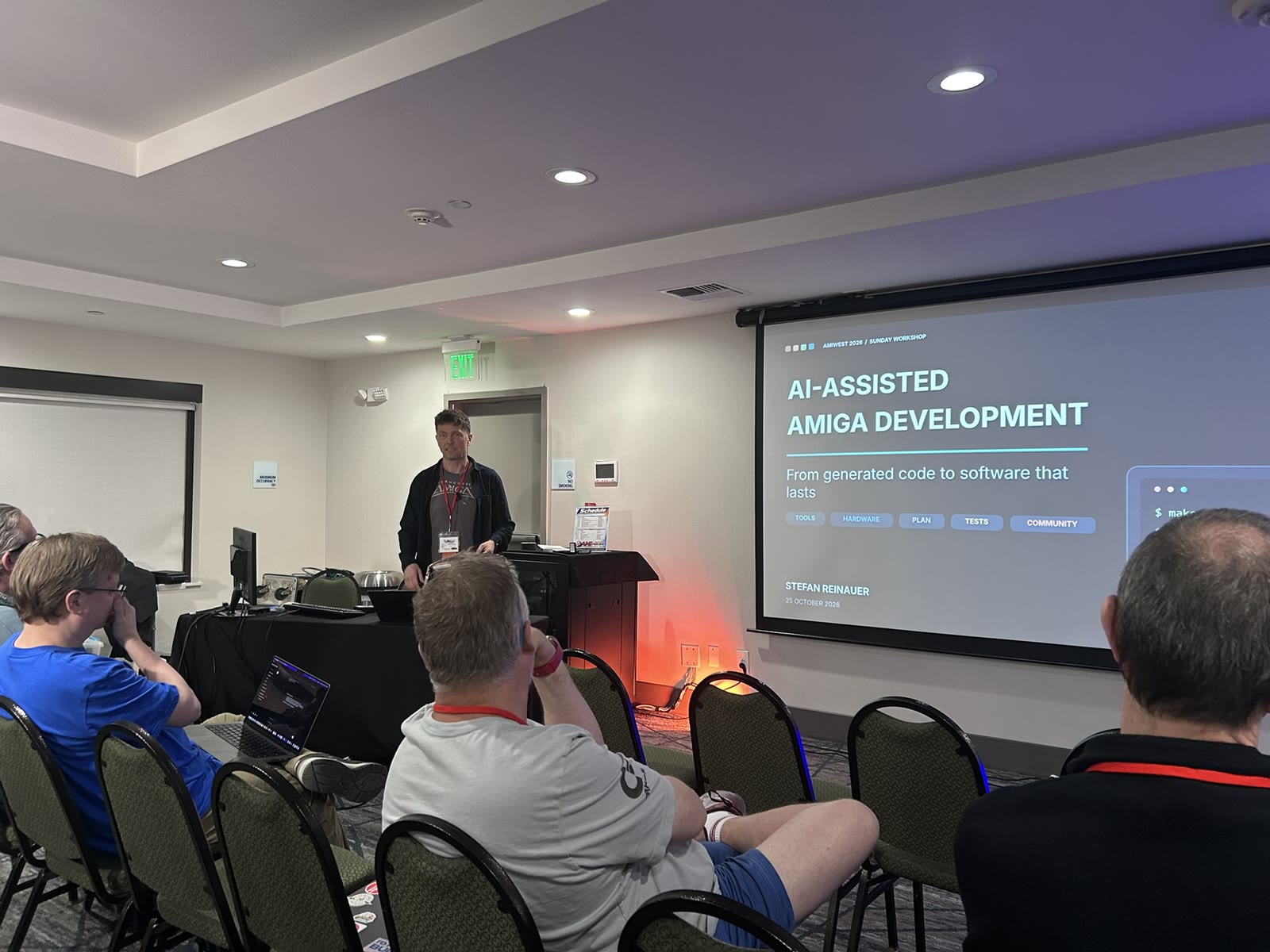
The photographed title slide frames the session around tools, hardware, planning, tests and community.
Chris Collins: a bench between the modern host and the Amiga
The organisers describe Chris Collins as a professional developer who has built tools for both AmigaOS 3 and AmigaOS 4, including DevBench. That name is a useful clue to the workshop's shape. The modern workstation is not the destination; it is the bench where prompts, source files, compilers, emulators and test steps can be arranged before the result reaches an emulated or physical Amiga.
The Amiga DevBench repository gives us something concrete to study. We can ask what the bridge exposes, which parts are deterministic, and where a human still needs to inspect the target. That is more interesting than treating AI as a magic code generator. A useful bench should make the next test easier to name and the failed test easier to repeat.
Stefan Reinauer: hardware history stays in the toolchain
The programme places Stefan Reinauer alongside Chris in the workshop, while the exhibition material also lists his A4091 and A4092 SCSI controller work. The same material points to ODFileSystem, xSysInfo, AmiFuse, and the A4091 software repository.
That combination matters to us because it keeps development attached to the machine's edges: storage, filesystems, diagnostics, benchmarks and devices. The programme's AI angle is only useful when it helps us understand those edges rather than hide them behind a polished editor.
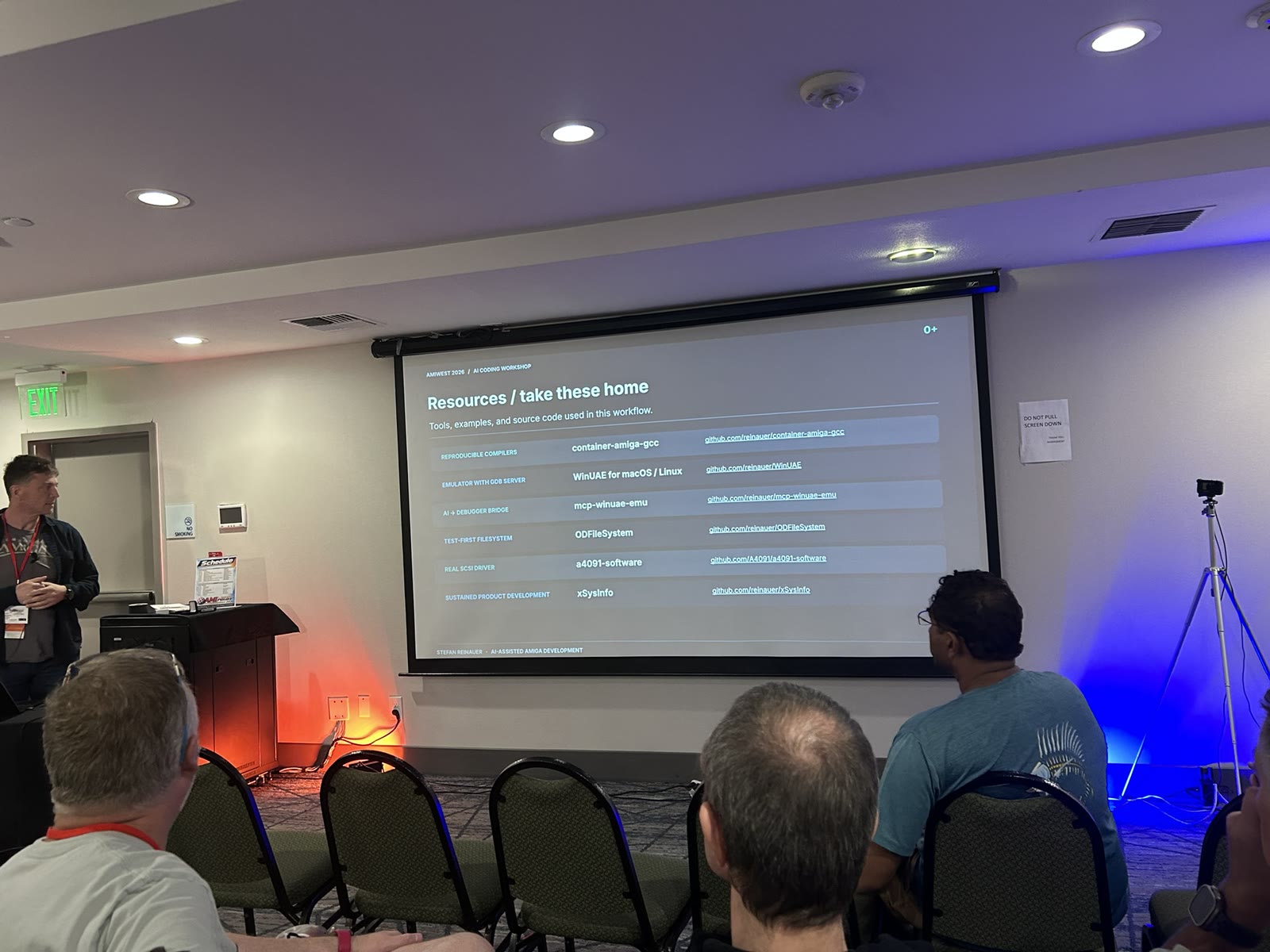
The resource slide turns a broad workshop idea into projects we can inspect one at a time.
The bridge is the lesson
The workshop announcement recommends bringing a laptop, a virtualised Amiga platform, an AI service or local model, and an idea. We read that as a small loop:
choose a bounded change
build it on the modern host
run it against the emulated or real target
inspect the result
keep the evidence
That loop looks familiar from our infrastructure work. The target is smaller, but the discipline is the same. We do not need to pretend that a generated patch is finished. We need a build, a test, a result and enough notes for us to try the next change without starting from a blank page.
What we want to investigate next
For our own projects, we want to trace one small path from source to target: one editor change, one build, one launch, one visible result. MuIRC, AmiWriterMUI and the ReAction editor experiments give us useful candidates. The workshop projects give us more bridges to examine, while the real Amiga still gets the final vote.
Our AmiWest show-floor recap holds the photos and the broader weekend notes. This follow-up narrows the view to the development bench Chris Collins and Stefan Reinauer helped put in front of us.
Photos: Auzietek's AmiWest 2026 collection. Project names and links remain credited to their authors and the AmiWest organisers.