It is not that large language models do not work.
They are fantastic where the training distribution is dense: readable
find regexes, systemd skeletons, Grafana panels, Puppet or Ansible
shapes you already understand, Docker Compose, APK/abuild culture,
“trigger a pipeline and keep a receipt.” Ask for those and you often get
something you can review in minutes.
They fail — or more precisely, they almost succeed while skipping the point — where the map is sparse. That failure looks a lot like a self-driving car and a bush. The road-shaped world is in the prior. The bush is not. The car does not “almost” understand the bush. It invents a confident wrong action near the bush, then invents another one after the first wrong action.
Both sides matter. Success on common patterns is real. Failure on sparse ones is also real. The useful article is about that density, not a score against the model.
A companion ThinkTank note, Imitated Intelligence, covers what an LLM actually is. This piece stays on the operator side.
Success analogue: AlpinE on a mainstream spine
AlpinE is the bet that you can keep readable intent while sitting on a living, mainstream package culture. Alpine recipes, abuild, apk, and the enormous public corpus of “how do I build this on Alpine” pages are exactly the kind of dense prior models already have.
That does not make AlpinE trivial. It does mean an assistant is not
fighting every DistroWiki page at once. The spine is familiar: fetch,
patch, build, package, install, prove. Readable shelves and product taste
can ride on top without requiring the model to invent a fifth lib
before breakfast.
When we say “AlpinE until the models catch up,” we are not saying AI is useless. We are saying: put the bot on the road while the bushes are still bushes.
Mostly common: BlackKnightController
Somewhat strangely, BlackKnightController is mostly a common pattern too.
Pipelines, stages, receipts, git sync, lab hosts, compose/swarm, “do not mutate production by raw SSH” — that is familiar automation fabric. Ask a model to sketch a pipeline JSON, a health gate, or a content canary that syncs Markdown and hits a bootstrap URL, and it will often land something syntactically correct that actually runs.
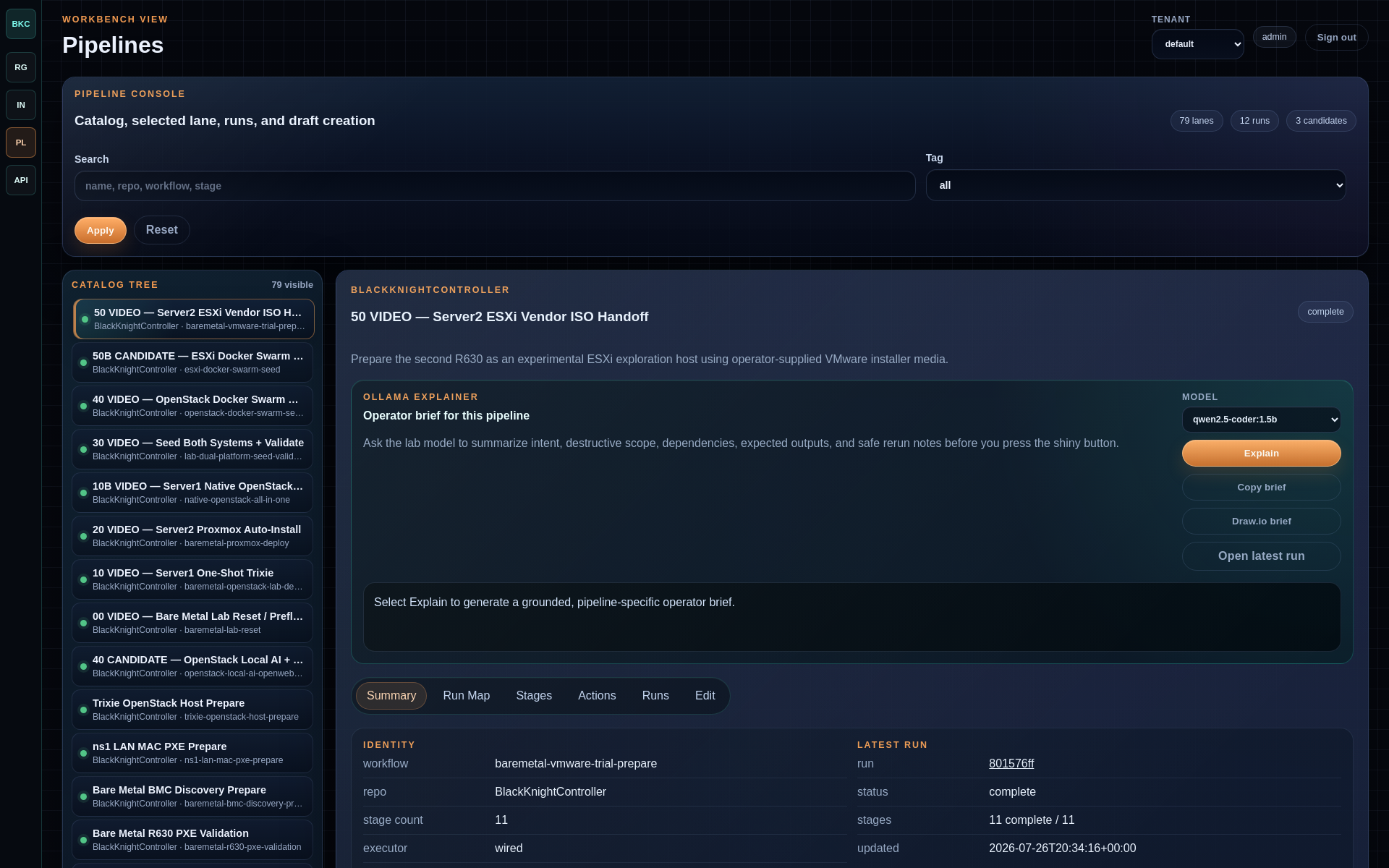
That success is important. It is why AI-assisted lab work is worth doing at all. BKC is not a private language invented to confuse bots. It is boring CI/CD taste with a paper trail.
Where BKC still looks like a bush
The uncommon bits are where the same assistant falters without making the pipeline “broken.”
BKC wants structured transforms: environment, Jinja (or equivalent)
templates for scripts and configs, bkc-cli for trigger / send /
receipt, make the file executable through the known path. That is the
feature set.
What models are wired to do instead is the dense prior for “get it done”:
- hardwire a host, path, or flag that should have been
envor a template variable; - drop a one-off shell fragment beside the pipeline instead of extending the template;
- run the mutating command directly over SSH even though
bkc-cliand a paper trail already exist; - craft a bespoke send/execute path, fail three or more times, then eventually get there.
The resulting pipeline is often still syntactically correct. Stages complete. URLs respond. Receipts exist. What got skipped is the key feature: parameterization, reusability, the boring structured transform you already paid for.
That is the bush in a common-pattern product. Not a crash. A miss of the point that still looks like a green run.
It is the same muscle as “I have bkc-cli and I still typed the docker
exec by hand.” Wired in. Eventually works. Leaves hardwired crumbs.
Sparse bush: custom layouts and Amiga-shaped assigns
Custom Unix layouts that refuse Debian Policy as physics are a thicker bush.
Readable volumes such as:
/Programs/<Name>/<version>/Commandsinstead of a pile ofbin/sbin/Librariesinstead of anotherlib/lib64apology/System/Settingsand/System/Stateinstead of treatingetc/varas the design
…are culturally old (Unix notes, Amiga, Atari, Mac) and statistically
rare in public text. Short names were a compiler and filesystem limit,
not the design. Putting a library on /Libraries is putting it back —
but almost every Stack Overflow answer will pull toward /usr.
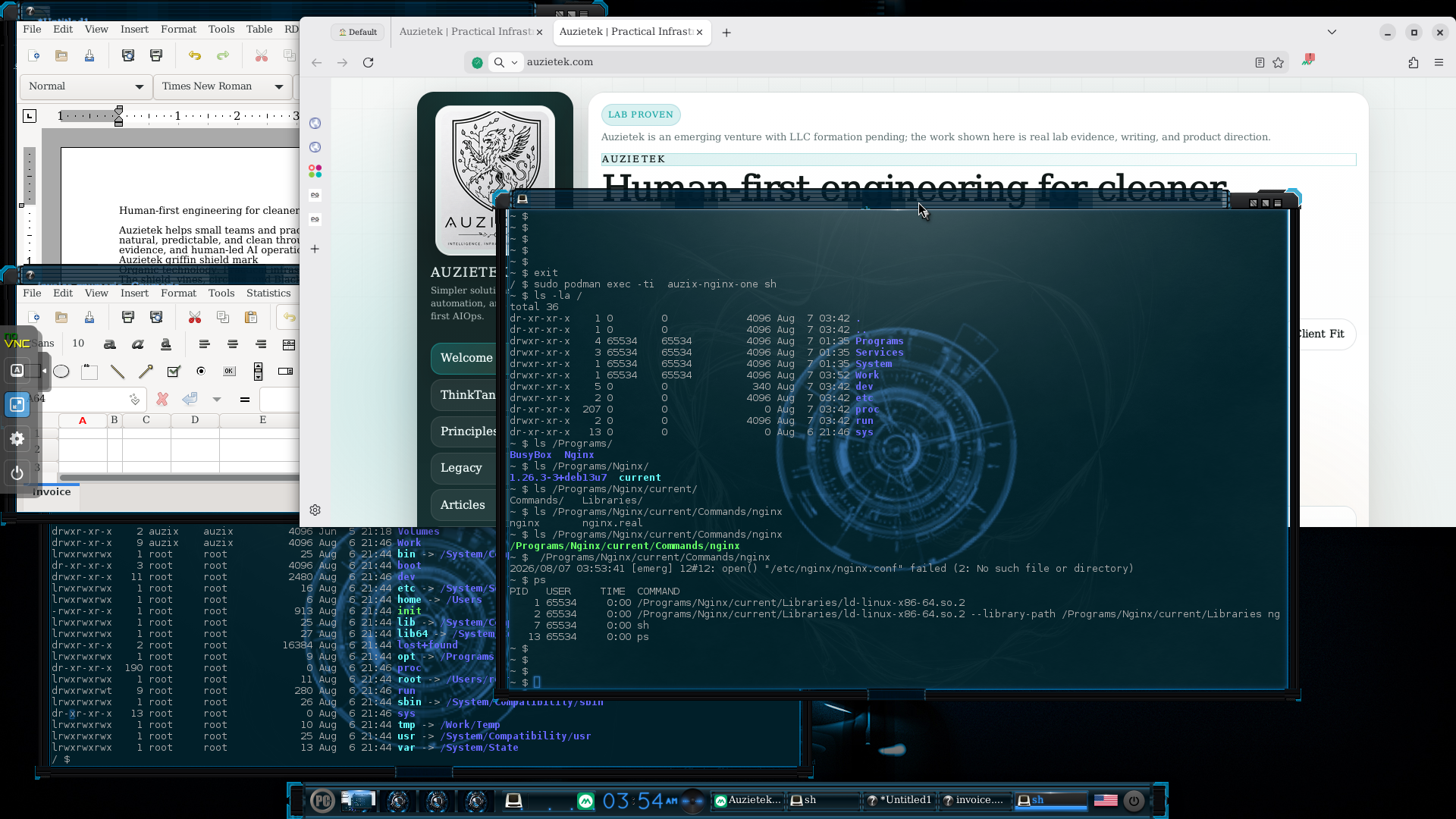
If a human checks out the tree, pulls a package, extracts the source, runs a small set of path replacements, and packs the result, they can nail a large fraction of a catalog with roughly eighty lines of honest bash and a few weeks of boring checks. One map. Hard stop on the first miss.
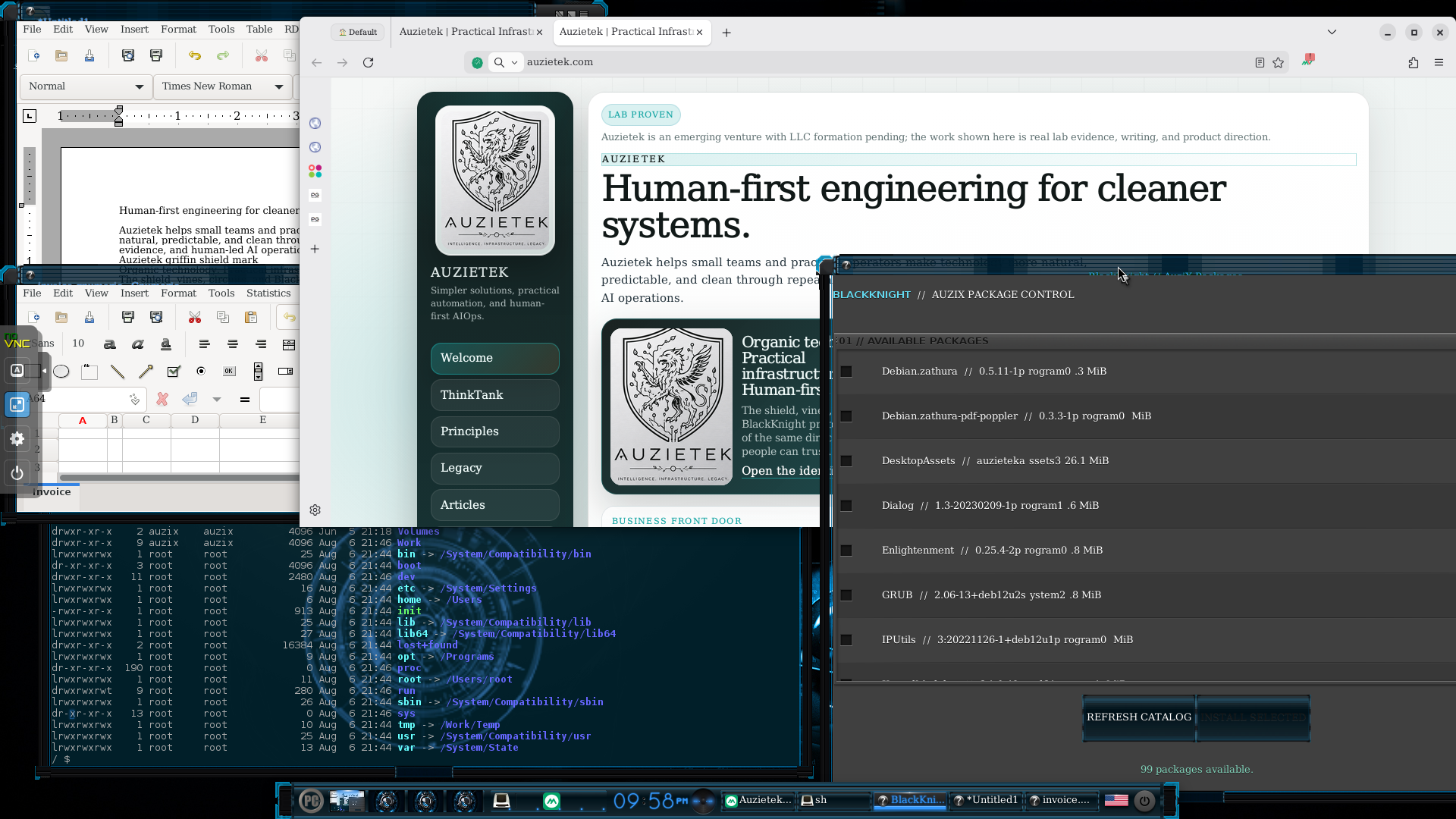
Ask a model to own that intake across many packages and you get a different failure class than BKC’s hardwired crumbs:
- Rewrite the builder host by accident. Compatibility shebangs in
configureso the Alpine builder cannot execute it. - Report success on an empty shelf. Continue-after-failure wrappers that look complete with zero APKs.
- Overlay guest libc onto the compiler. Host
readlinkthen loseslibcrypto. - Drop a known-good config for bare
defconfig. BusyBox TC comes back;TCA_CBQ_MAXlooks like a kernel mystery and is not. - Force target linker flags onto host link lines. apk-tools cannot
find
-lssleven withopenssl-devinstalled for the builder.
None of that requires genius to avoid. It requires holding one boring
contract without inventing a fifth lib — the same discipline as
“use the template, use bkc-cli,” applied to a thinner prior.
Amiga-shaped work sits here too: PROGDIR:, LIBS:, SYS: are real
culture with a thin corpus. Models invent modern desktop metaphors
instead.
Density, not morality
Mainstream Linux text is overwhelmingly FHS-shaped. Distro policy,
aports, Debian helpers, and “don’t invent an OS” advice all pull toward
/usr and /lib. Alpine build culture is dense. Generic pipeline YAML
is dense. Your house Jinja-for-scripts convention and your custom volume
map are sparse.
The model’s prior is not evil. It is statistical. When uncertain, it falls back to the dense prior: hardwired paths, Compatibility as a rewrite target, one-off SSH, another package-specific exception.
Mortals leave the mainstream too far without a ledger and get the same disease: orphaned logic, lost logic, hardwired one-offs. Chat memory is not a ledger. A green unit test is not a packed APK. A live patch is not a fresh image proof. A green pipeline stage is not proof you used the structured transform.
What LLMs are good for here
They are good at:
- drafting the eighty-line sketch once a human has named the map;
- riding AlpinE / Alpine-shaped build loops;
- sketching BKC-shaped pipelines that sync, prove, and leave receipts;
- writing tests that assert the map or the template contract;
- summarizing a failed run from a receipt;
- proposing a bounded next check;
- turning a finished lab note into a Linux Users teaching article.
They are not yet good at owning sparse contracts — custom volume maps,
Amiga assigns, or “always Jinja + env + bkc-cli” — across a long
session without adult supervision. They will still produce working
one-offs that skip the feature you cared about.
Operator rules that match the density
- Prefer a mainstream spine (AlpinE / Alpine culture) when the bot must move volume.
- Write sparse contracts outside the chat: volumes, template vars,
fail-closed pack,
bkc-clipaper trail. - Treat green syntax as necessary, not sufficient. Ask whether the key feature ran (template, env, receipt) or only a one-off.
- First miss stops the list. Empty repositories are not complete.
- Prefer reusing a known config or finished binary over reinventing configure flags from vibes.
- When the next failure is another reinvented corner, stop. That is
evidence about density, not a dare to grind
rNforever.
Honesty about the maybe
Custom path intake with a strict empty-root proof can remain a maybe. Pieces can prove without an agent-complete catalog.
AlpinE can remain the working bet. BKC can remain mostly road, with
honest notes where Jinja and bkc-cli still lose to wired-in habits.
That is not an anti-AI sermon. It is a portability note for people who build real systems with these tools.
Self-driving cars will get better at bushes. Models will get better at sparse layouts and house template discipline. Until then, the prize is not breaking the LLM. The prize is matching the job to the density — eighty lines of bash and a map you can still read when the chat is gone, or a mainstream spine the prior already knows how to drive.
Assumptions and scope
- Evidence is from Auzietek lab work on custom source intake, AlpinE posture, and BKC pipeline assistance through September 2026.
- This article does not claim factory completion or that BKC is defective.
- Companion: Imitated Intelligence — LLMs as a giant smart macro.
Related lanes
- Linux Users: AI-assisted ops with receipts, not vibes.
- Retro Users: why Amiga assigns and readable shelves still matter.
- BlackKnight / ThinkTank: human-first automation, paper trails, and knowing when the green stage skipped the feature.