The recent lab grew past a single hypervisor story.
Server1 became the OpenStack side. Server2 became the ESXi side. Proxmox stayed near the edge. Docker Swarm workloads moved into the new platforms. Portainer, Grafana, Horizon, edge routing, DNS, and SSH jump paths all had to keep making sense from the operator workstation.
That is where BlackKnightController starts to feel different from a pile of scripts.
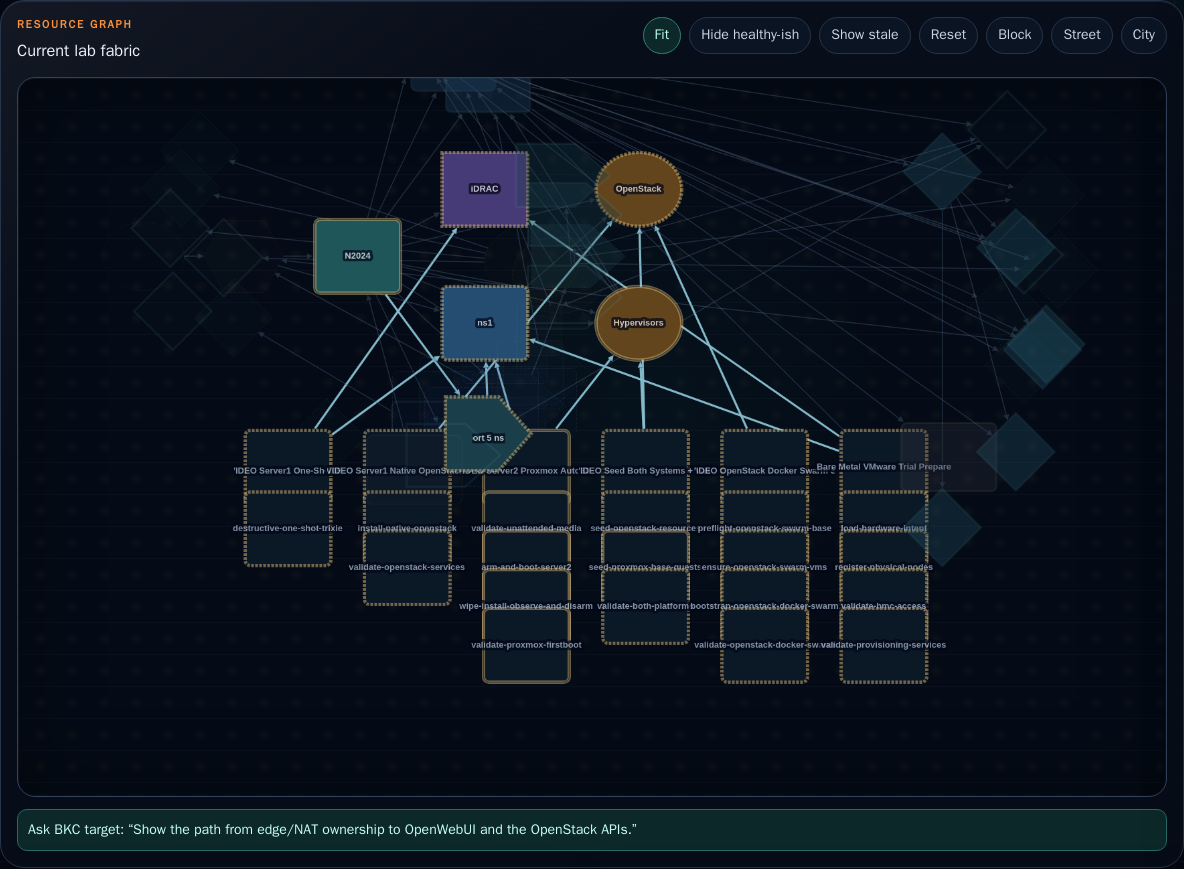
The split platform pattern
The final demo shape looked like this:
OpenStack lane
  -> build tenant VMs
  -> bootstrap Docker Swarm
  -> validate SSH, Docker, and OpenStack server state

ESXi lane
  -> clone known-good Debian base guests
  -> pin DHCP/MAC identity
  -> bootstrap Docker Swarm
  -> expose Portainer agent path through the lab edge

Edge lane
  -> keep workstation-friendly URLs
  -> route web UIs
  -> preserve Docker context / ProxyJump notes
  -> keep Grafana and Portainer useful as operator views
The point is not that every platform should run the same way. The point is that the operator should not have to mentally reload the entire environment every time the target changes.
Known proof from the ESXi side
The ESXi side reached a very concrete state:
ESXi swarm manager: 10.20.0.121
Docker context route: ssh://bkc-esxi-swarm-mgr-01 via ProxyJump bkc-edge
Portainer agent route: swarm1.lab.auzietek.com:19091 -> 10.20.0.121:9001
That is the kind of detail worth preserving. It tells the next operator where the service actually lives, how the workstation reaches it, and which edge port is translating the lab-only network into something usable.
OpenStack needed a different boundary
The OpenStack control plane was healthy, but tenant SSH routing still needed the final management route or floating-IP decision before it should be presented as a workstation-native Docker context.
That is a good example of BKC honesty. Do not call the entire story done because one layer is green. Mark the exact boundary:
control plane healthy
tenant workload created
service-side route pending
workstation-native context not yet promoted
That lets the next run start from evidence instead of vibes.
Why the edge matters
The workstation normally cannot route directly to every 10.20.0.0/24 service.
That is intentional. The lab edge exists to present useful entry points without
pretending the private network is flat.
Web UIs go through edge routes. Docker CLI contexts use SSH aliases and ProxyJump. Portainer uses agent endpoints, not raw Docker TCP. Grafana becomes the shared “what is alive?” view.
That is the practical fabric BKC is building:
different platforms -> consistent operator paths -> validated evidence
The lab is not replacing every tool. It is connecting them into a shape an engineer can understand, repeat, and teach.
Why several control planes are normal
Real environments rarely have one perfect control plane. Even a small lab can have Proxmox, ESXi, OpenStack, Docker Swarm, Portainer, Grafana, DNS, DHCP, a firewall, a managed switch, and hardware controllers. Commercial environments look the same, only with more names and more meetings.
BlackKnightController does not need to defeat those tools. It needs to keep the operator-facing contract sane:
where does this service live?
how do I reach it from the workstation?
what changed recently?
which pipeline created or repaired it?
what evidence says it is healthy?
That is why the lab edge became so important. Horizon, Proxmox, ESXi, Portainer, Grafana, OpenWebUI, micro-blog review sites, and future service demos all need friendly entry points. The edge can use direct proxying where HTTP is simple, NAT where the protocol needs it, and SSH jump paths where the management plane should stay private.
The move-in day pattern
The more interesting work started after the hypervisors were installed. A bare hypervisor is only a parking lot. The lab needed to move in:
known-good Debian base
  -> clone guests
  -> depersonalize identity
  -> pin MAC and DHCP
  -> install Docker
  -> join managers and workers
  -> expose Portainer agent
  -> attach monitoring
  -> publish operator URLs
That sequence is reusable. It can become an ESXi lane, an OpenStack lane, a K3s lane, or a small-office lane. The target APIs differ, but the operational story remains the same: create machines, give them stable identity, configure the service fabric, validate it, and publish how a human reaches it.
What still belongs in future passes
The lab is intentionally alive. The next improvements are not mysterious:
- stronger OpenStack tenant networking for workstation-native access;
- richer Grafana dashboards for hypervisors, swarms, and edge services;
- Portainer endpoint wiring for each swarm;
- DNS and certificate rotation as pipelines;
- optional firewall/VPN routing through IPFire or a similar edge appliance;
- article-to-repo companion kits for people who want to reproduce pieces without running BKC.
That last point matters. BKC is the flagship, but the public material should also teach. A reader should be able to understand the pattern, then choose the tooling level that fits their environment.